

Mn²⁺ Ion-Mediated Zn Dendrite Suppression and Reversible Stripping in Aqueous Zn-Ion Batteries as Revealed by In Situ Liquid-Cell TEM
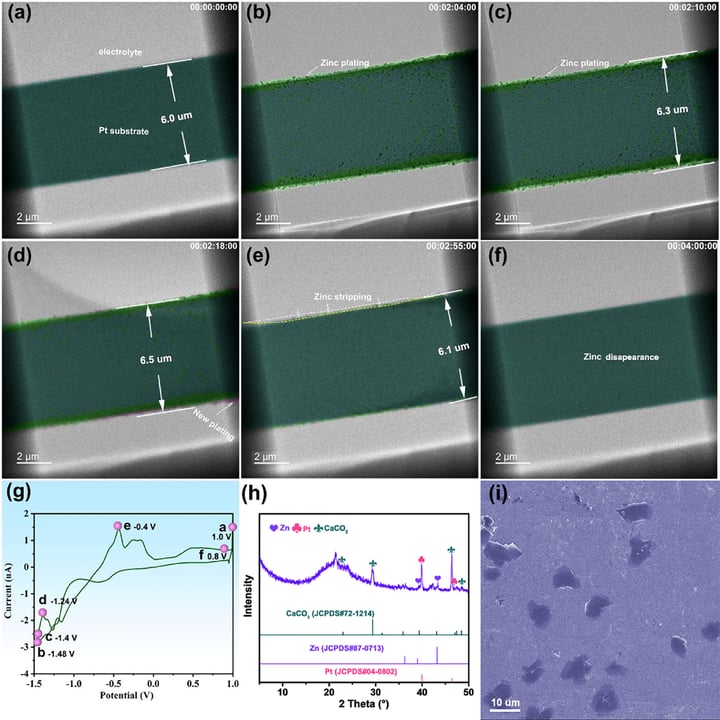
In situ electrochemical liquid-phase TEM (EC-LPTEM) reveals, in real time and at the nanoscale, how an electrolyte additive controls Zn electrodeposition in aqueous zinc-ion batteries. Chen et al. imaged Zn plating and stripping in flowing ZnSO₄ inside the microscope, under identical conditions with and without MnSO₄. Without the additive, Zn grows as branched dendrites (~2 µm within 2 s), and stripping leaves residual deposits. With Mn²⁺, deposition is uniform and dissolves almost completely within 20 s. This is linked to Zn–Mn–O–S deposits at the electrode surface that dissolve easily, with Mn staying as Mn²⁺, which points to interfacial modulation rather than redox chemistry. Coin cells confirm the trend: Zn symmetric cells ran for more than 1400 cycles with Mn²⁺, versus failure after 520 without it. Post-mortem methods cannot capture these early nucleation and growth dynamics, so EC-LPTEM provides a direct mechanistic link between electrolyte chemistry and deposit morphology, guiding the design of dendrite-free Zn anodes.