Catalysis
Observe catalyst dynamics, sintering and reaction mechanisms at atomic resolution under realistic gas environments.
Watch catalysts work under real reaction conditions
Catalysts are at the heart of countless industrial processes, enabling the efficient production of fuels, chemicals, fertilizers, and sustainable energy carriers. However, catalysts are not static materials. Under realistic reaction conditions, nanoparticles, supports, interfaces, and active sites continuously evolve, often determining catalytic activity, selectivity, and stability.
DENSsolutions Climate enables researchers to study catalysts under realistic gas environments, elevated temperatures, and operando reaction conditions inside the electron microscope. This provides direct insight into catalyst restructuring, metal-support interactions, phase transformations, and active-site evolution, helping accelerate the development of next-generation catalysts for sustainable energy and chemical manufacturing.
Platforms for this research area
Climate∞
A gas environment with heating and biasing. Observe catalysts and materials under realistic pressures and temperatures.
HydroBolt
Liquid-phase electrochemistry in the SEM. Study electrocatalysts under working potentials with realistic electrolyte volumes and correlate activity with structure.
Featured research
Featured experiments
A selection of recent publications enabled by DENSsolutions in situ TEM platforms.
Looping metal-support interaction in heterogeneous catalysts during redox reactions
Defective tiox overlayers catalyze propane dehydrogenation promoted by base metals
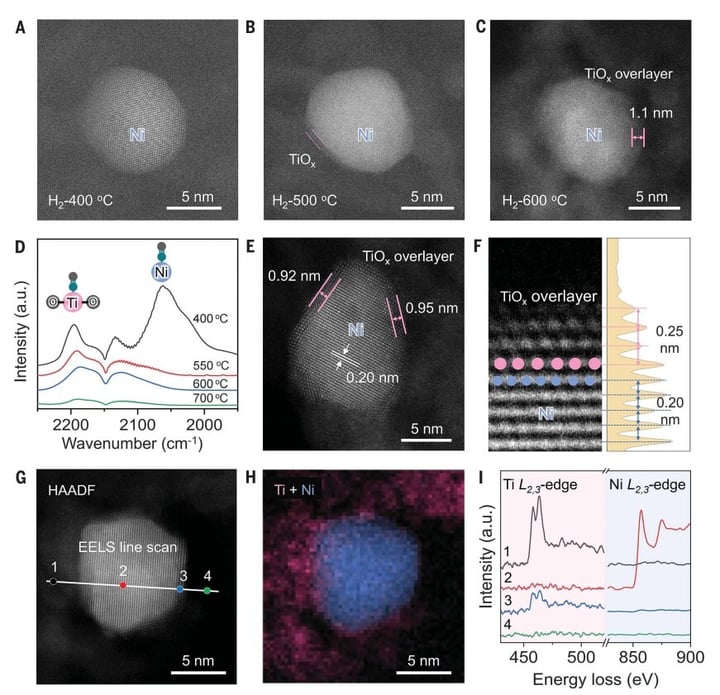
Restructuring of titanium oxide overlayers over nickel nanoparticles during catalysis
Dynamic interplay between metal nanoparticles and oxide support under redox conditions
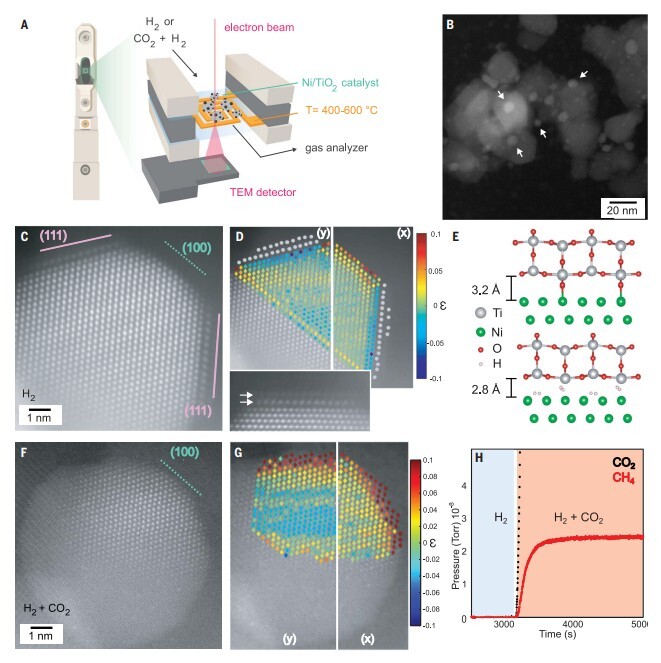
This landmark Science publication demonstrated that metal nanoparticles and oxide supports exhibit a highly dynamic and interdependent relationship under redox conditions. Operando gas-cell TEM revealed continuous restructuring, migration, and interaction between catalyst components, fundamentally changing our understanding of catalyst behavior. The work provides one of the clearest examples of why catalysts must be studied under realistic reaction conditions rather than in static environments.
Publications
Top research in Catalysis
Loading publications…
Advance your catalysis research
Talk to our application specialists to find the right in situ TEM platform for your experiments.
Get in touch