In Situ TEM

Climate Infinity

In situ TEM gas, heating & biasing

Expand your research capabilities with our pioneering 8-contact environmental TEM holder, enabling simultaneous in situ electrical and thermal characterization of samples in controlled gas environments.

Turn your TEM into a real-world research laboratory

The DENSsolutions Climate Infinity enables atomic-resolution imaging of gas-solid interactions by combining controlled gas environments with simultaneous heating and biasing. A dedicated MEMS-based Nano-Reactor provides a leak-tight sample environment, turning your TEM into a real-time chemical reaction chamber.

By revealing how structure and chemistry evolve upon reaction in real time, rather than relying on static pre- and post-reaction snapshots, Climate Infinity accelerates the discovery and development of novel catalysts, functional materials and synthesis techniques.


Bringing Real-World Gas Reactions to Your TEM

01

Combined Electrothermal Stimuli

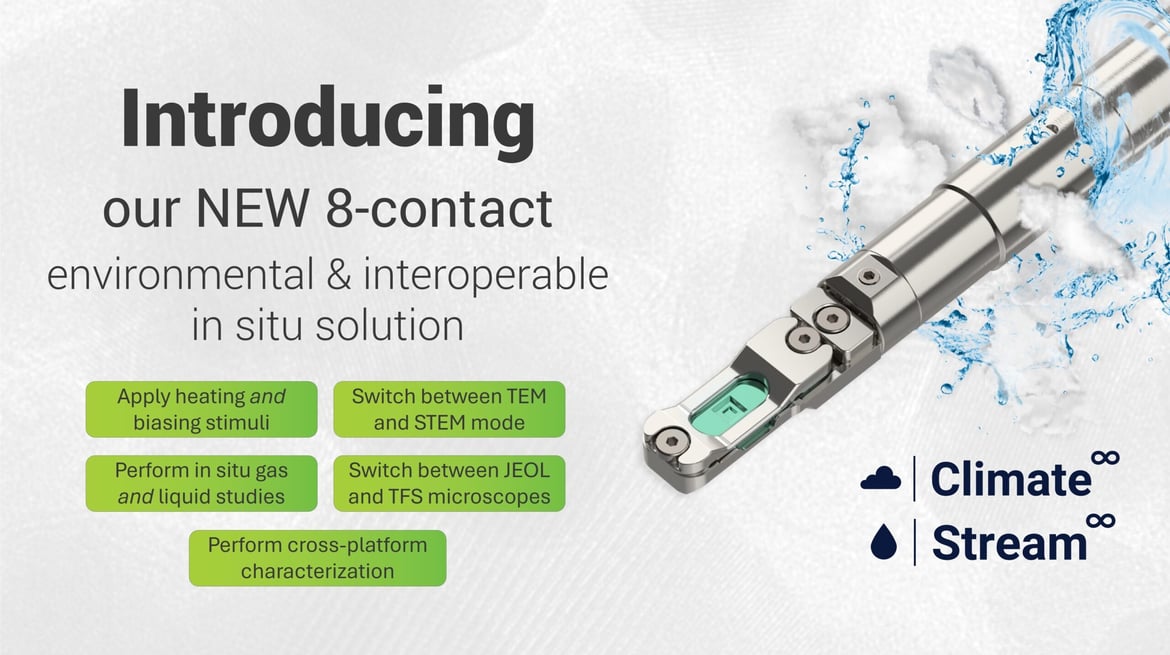
The new Climate Infinity holder features eight electrical contacts that enable simultaneous application of electrical and thermal stimuli in a controlled gas environment. The increased number of the contacts of the holder can also be used to drive various custom MEMS-based sensors and actuators, making the Infinity platform essentially a multi-functional research playground.
02

Advanced imaging and analytical capabilities

By flipping the tip 180 degrees, you can directly change the sample position to be either on the top or bottom without a need to disassemble the tip. This grants you the freedom to flawlessly switch between STEM or TEM mode, respectively, depending on your experimental needs, while maintaining the best resolution performance. Importantly, you can switch between both imaging modes within a matter of seconds.
03

Drive multi-scale research across instruments

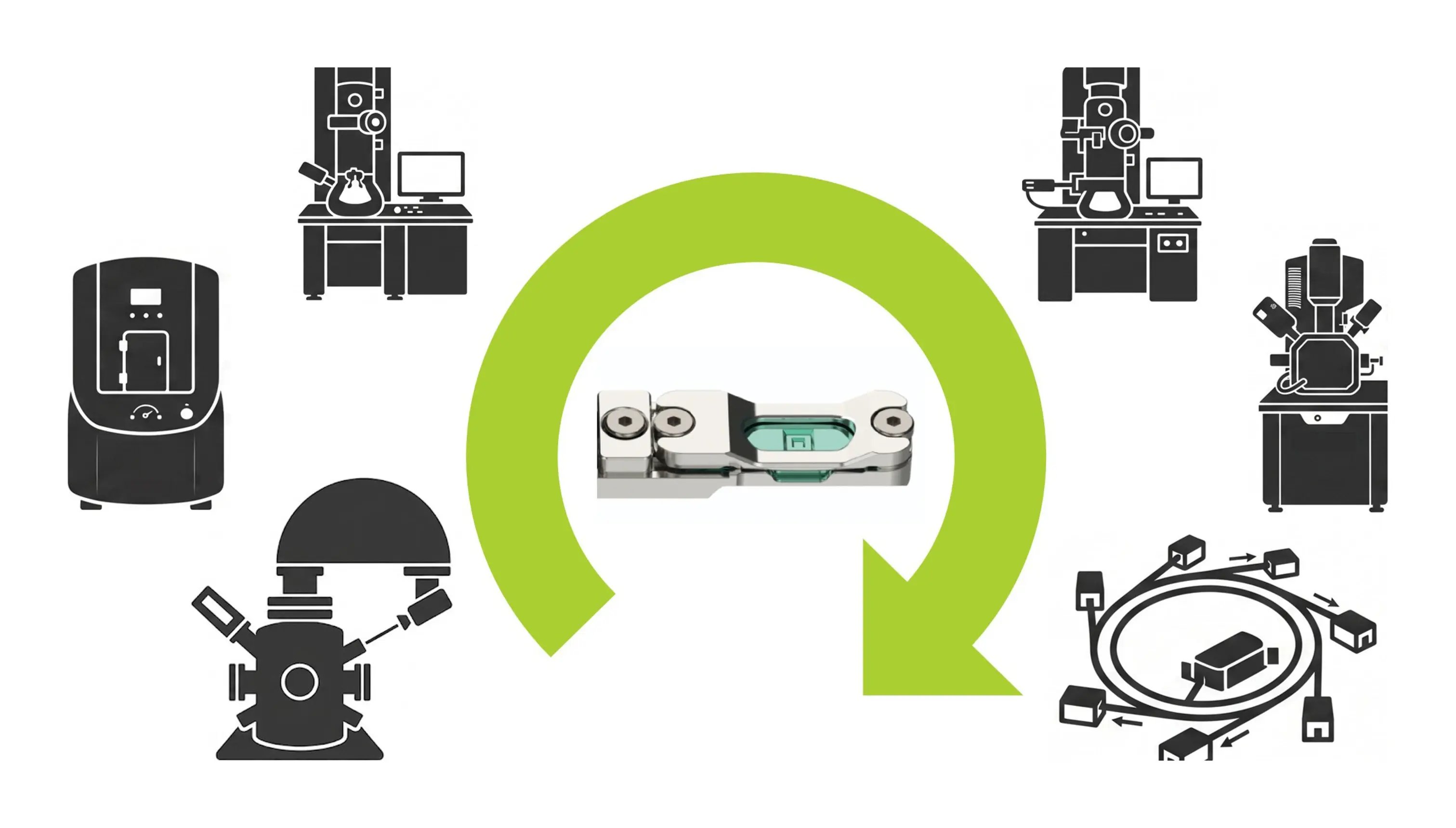
Designed for seamless cross-correlative workflows, the modular Infinity holder has a universal removable tip that acts as a portable cartridge. You can now bridge SEM, TFS TEM, JEOL TEM and beamline platforms with advanced X-ray techniques like TXM, XRF and Ptychography. This feature enables correlation of multi-scale data across facilities or institutes without requiring Nano-Reactor disassembly, and therefore preserves complete sample integrity.

On JEOL microscopes the universal tip applies to TEMs with wide pole pieces such as HRP and WGP.

The removable Infinity tip circulating between SEM, JEOL and Thermo Fisher TEMs, a beamline and X-ray platforms
04

Perform gas and liquid studies with the same holder

The new environmental Infinity holder is your all-in-one solution for both gas and liquid experiments. Simply choose the appropriate function for the chips and connect the necessary gas or liquid supply system. Our extensive range of chip types includes gas-heating (GH), liquid-heating (LH), gas-heating-biasing (GHB), and liquid-heating-biasing (LHB), offering unparalleled versatility for your experimental needs. New MEMS chip designs can further expand the application space of the Infinity system.

Climate Infinity application fields

climate-nanomaterial-growth

Nanomaterial growth

Observe nanomaterial synthesis and growth processes in reactive gas environments at elevated temperatures.

climate-heterogeneous-catalysis

Heterogeneous catalysis

Study catalyst dynamics and structure evolution during real-world gas reactions at sub-Angstrom resolution.

stream-fuel-cells

Fuel cell research

Investigate electrode materials and membrane degradation under controlled gas and temperature conditions.

climate-corrosion

Corrosion studies

Visualize oxidation and corrosion mechanisms at the nanoscale in controlled atmospheric environments.

The Climate system

Overview of the key components that together enable precise environmental control and in situ experimentation within the Climate system.

Nano-Reactor

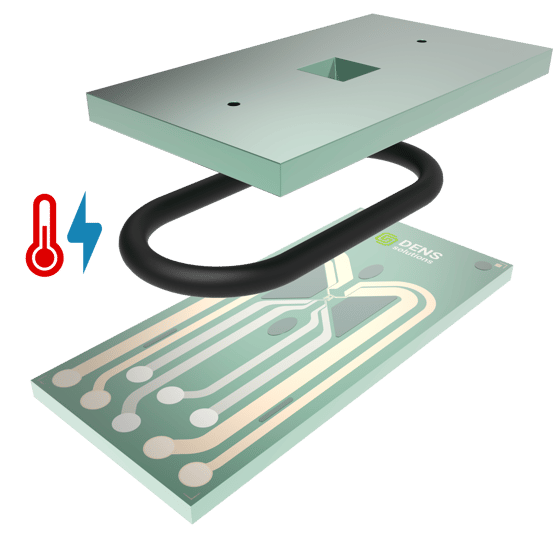
Powered by advanced MEMS technology, the Nano-Reactor is a functional sample carrier that creates a controlled and clean reactive environment for imaging chemical reactions at the nano-scale. An integrated four-contact micro-heater and sensor delivers precise and localized temperature control from room temperature up to 1000 °C. Combined with four dedicated biasing contacts, the eight-electrode architecture enables combined heating and biasing experiments. Replicating a real-world industrial chemical reactor, the Nano-Reactor unlocks atomic resolution imaging during dynamic gas–solid reactions. 

Read more about the Climate Nano-Reactor
gas-heating-biasing-nanoreactor

Modular versatile sample holder

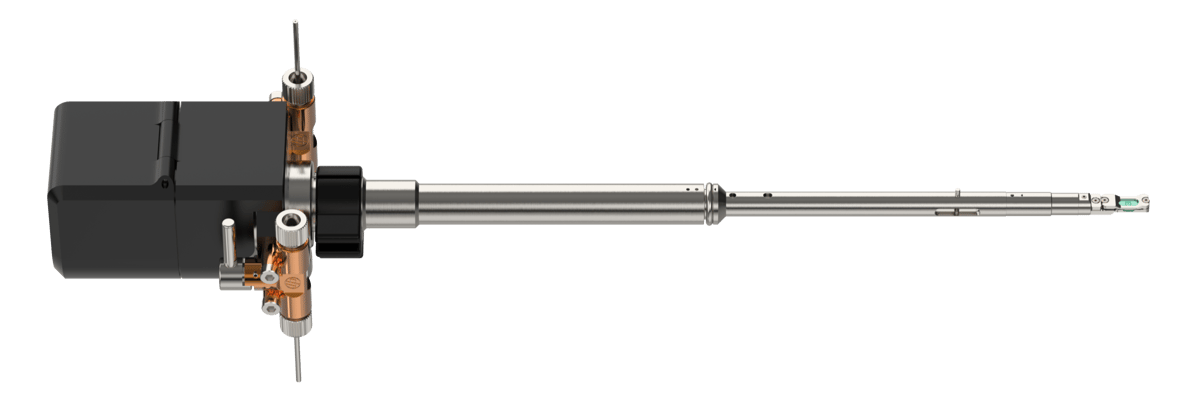
A clean environment is essential for in situ microscopy experiments. The modularity of the Climate Infinity Sample Holder allows for all components that come into contact with the reaction gases to be replaced or cleaned on-site by the user. This includes the gas tubing, metal tip & lid, O-rings and consumable Nano-Reactor. Air-free transfer is supported, so samples that must not be exposed to air can be brought into the microscope without ever seeing it.

Read more about the Infinity sample holder
TF-2-channel-holder-45-degree-Green_cropped-for-webpage

Gas supply system

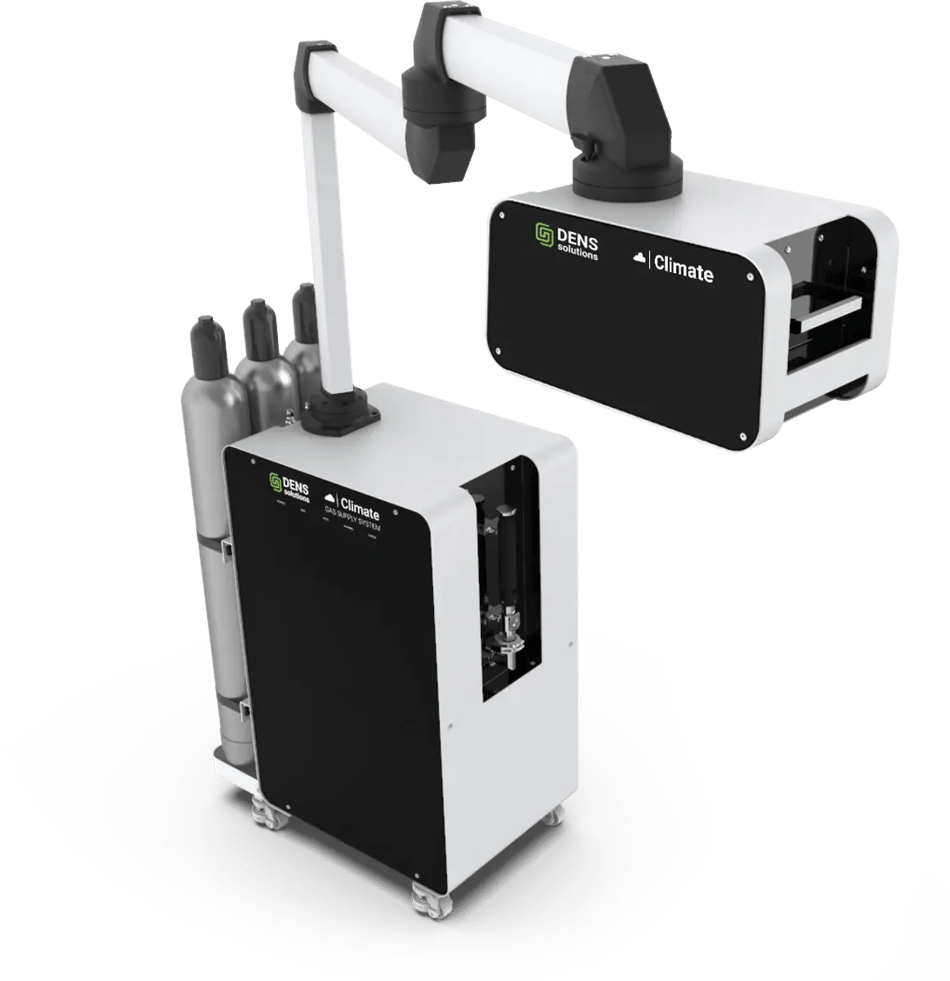
The Gas Supply System is a game changer for gas-phase TEM research, integrating all gas control functions into one smooth platform. It gives accurate and independent control over temperature, pressure, flow rate and gas composition directly inside the Nano-Reactor, in either static or flow operation, mixing up to three gas input lines on the fly with mass-flow controlled in-line mixing.

The unique ultra-low-volume mixing valve guarantees rapid gas switching and enables safe operation with flammable gases and explosive mixtures of any composition. Importantly, our Gas Supply System allows for imaging and analysis of samples in gas environments at the atomic scale.

Read more about the GSS
The Climate Infinity Gas Supply System, with its flow control unit on the microscope arm

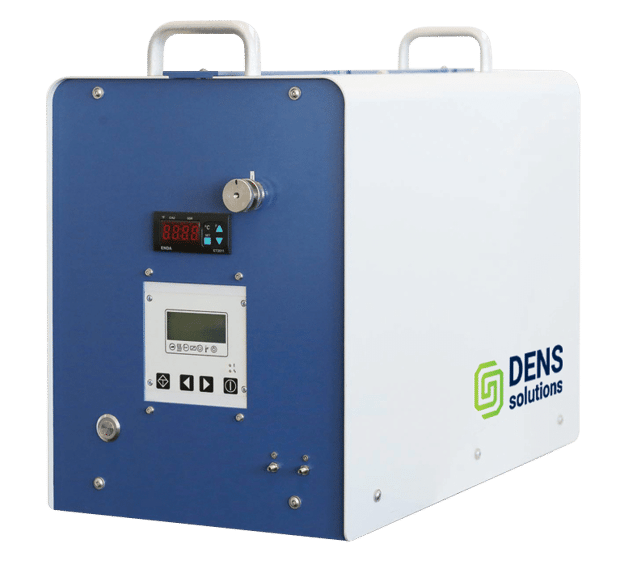
Gas analyzerOptional Add-on

Designed to seamlessly integrate with the Climate Infinity system, the DENSsolutions Gas Analyzer allows for precise analysis of gases generated during chemical reactions within the Nano-Reactor, even in minute quantities.
Read more about the Gas Analyzer
Gas-analyzer_new-logo

Vaporizer FlexOptional add-on

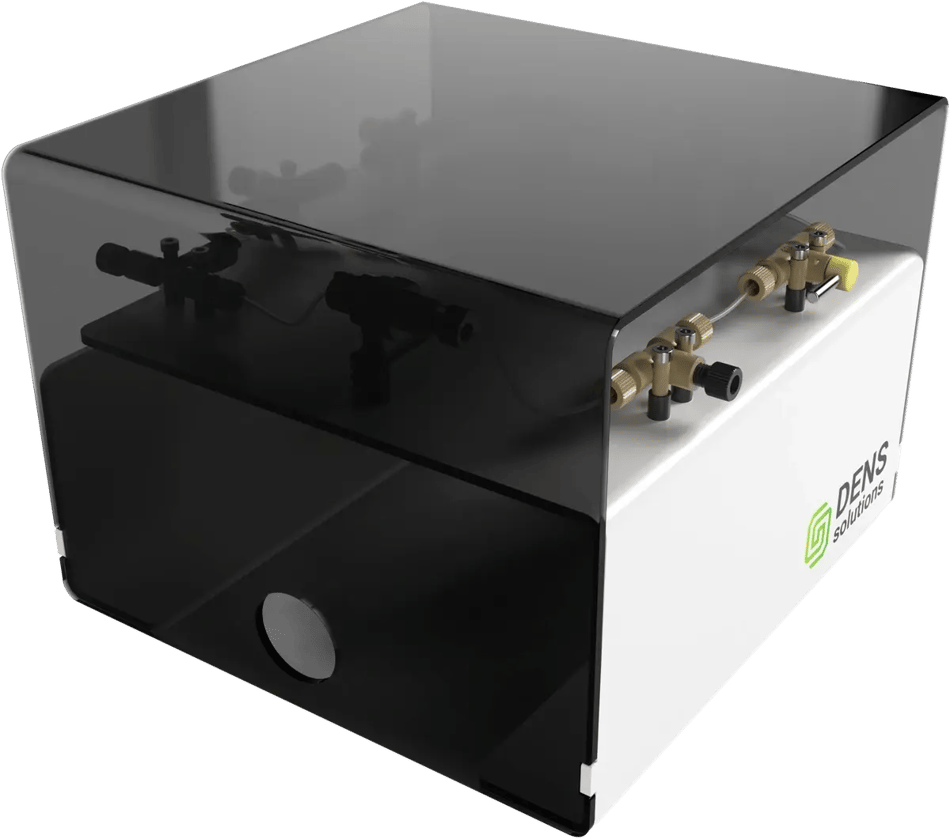
The Vaporizer Flex adds water or alcohol vapor to any gas mixture at the last stage before the holder, so the gas system itself stays free of vapor and needs no baking between experiments. Manual valves switch between dry and wet operation in minutes, and the bubbler reservoir takes any liquid that is chemically compatible with the system.

Read more about the Vaporizer Flex
The Vaporizer Flex, which connects between the gas system and the holder

Infinity LightOptional add-on

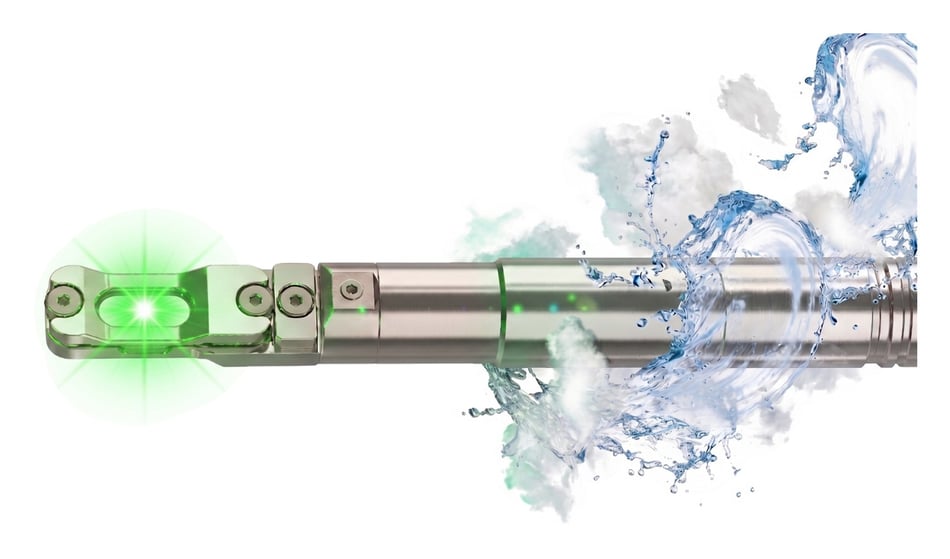
An optomechanical tip brings an optical fibre into the sample area, illuminating the entire 500 × 500 µm² membrane of the Nano-Reactor.  The supported wavelengths ranges from 350 to 2000 nm with up to 1500 mW/cm² at the sample.

Read more about Infinity Light
Infinity Light optomechanical tip illuminating a sample

Software

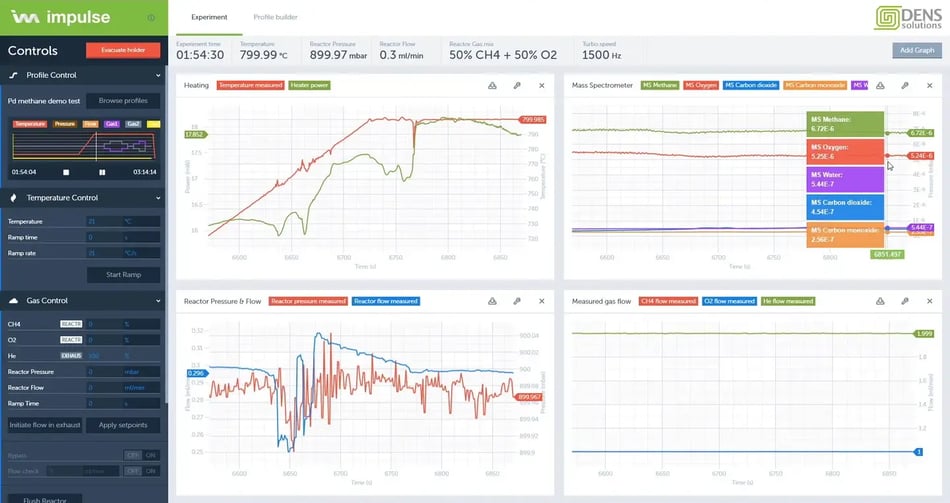
The DENSsolutions Climate Infinity system enables users to control critical parameters such as sample temperature, gas flow, pressure, and composition. Additionally, for gas experiments, it is essential to measure parameters such as calorimetry, reaction products and reactor conditions. Our Impulse software has been specially optimized to fluently integrate these large numbers of parameters, facilitating the automation and reproducibility of complex experimental workflows.
Read more about Impulse
The Impulse dashboard during a gas heating experiment, with live temperature, mass spectrometer, pressure and flow graphs

Nexus software

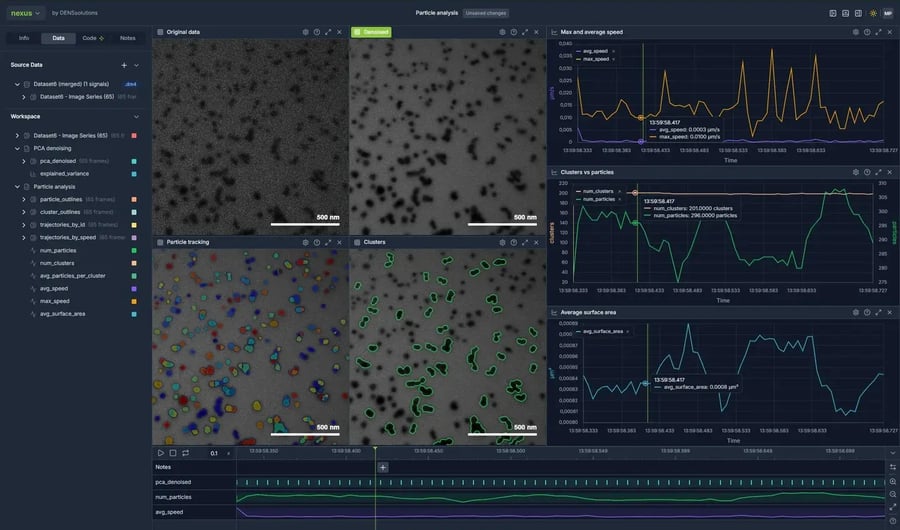
Nexus brings the whole experiment back together afterwards. Import data from GMS, TIA, Velox and Impulse into one synchronized workspace and view your TEM images alongside the temperature, pressure and gas signals on a shared timeline. Process the data in the same project with the bundled Python scripts for drift removal, smoothing and peak detection, or with your own, and export annotated videos and figures that combine images, graphs and metadata.

Read more about Nexus
The Nexus workspace showing a particle analysis: the original and denoised image series with particle tracking and cluster outlines, and the speed, cluster and surface-area signals on a shared timeline

Watch the full workflow

Watch the complete Climate Infinity workflow demonstrating every step of the experimental process.

What researchers say

We have been very impressed by the performance of the DENSsolutions Climate holder. It has enabled us to perform in situ low-dose atomic-resolution imaging under gaseous conditions, with results beyond our initial expectations. In both TEM and STEM modes, we were able to resolve beam-sensitive materials such as zeolites and hybrid perovskites at atomic resolution, which is critical for understanding their adsorption/desorption behavior and structural degradation mechanisms. We are now further extending this capability to in situ 4D-STEM ptychography, opening new opportunities for probing the structure of sensitive materials under realistic gas environments. 
Professor Yu Han
Professor Yu Han South China University of Technology
We have been extremely pleased with the Climate System. Working with the system has been incredibly easy and productive, allowing us to perform experiments more efficiently and with greater confidence. We have already seen measurable improvements in both workflow efficiency and user experience with the newest generation of the system. It has truly been a game-changer for our work.
Professor Dong Su
Professor Dong Su Institute of Physics, Chinese Academy of Sciences (CAS)
We have had an excellent experience with the DENSsolutions Climate System. The platform has enabled us to perform advanced in situ gas experiments efficiently and reliably, leading to many interesting results that are currently being analyzed for future high-impact publications. The system has become a valuable tool for our research and has opened new opportunities for studying materials under realistic environmental conditions.
Professor Yong Wang
Professor Yong Wang Center of Electron Microscopy, Zhejiang University

Learn more about the Infinity Sample Holder

Read about our Infinity holder in this interview with one of our senior engineers, exploring the vision behind this latest innovation. The article highlights how Infinity combines heating and biasing in both gas and liquid environments through its 8-contact design, enabling new possibilities for in situ experiments. It also reflects the user-driven approach behind the design, with a focus on ease of use, faster time to experiment, and seamless integration across microscopy platforms.

Introducing Infinity: DENSsolutions' pioneering 8-contact environmental in situ solution

Introducing Infinity: DENSsolutions' pioneering 8-contact environmental in situ solution

DENSsolutions introduces its latest product: Infinity – an innovative in situ solution that combines heating and biasing capabilities in both gas and liquid environments.

Read more

Other top research using Climate Infinity

Loading publications…

Frequently asked questions

Find answers to the most common questions about the Climate Infinity.

Can I safely use the Climate Infinity holder in my TEM?

Yes. The Climate Infinity holder dimensions are designed within the specifications for the applicable objective lens pole piece as provided by the TEM manufacturer (Thermo Fisher Scientific or JEOL). As long as the holder is also used within the Z- and T-axis range specified in the user manual, there should be no risk of the holder touching the pole piece. Before every insertion of the Climate Infinity holder into the TEM goniometer, it is tested for vacuum leaks with a turbomolecular pump. Only after this test is passed successfully, the user can continue to the next step of TEM insertion.

Which pole pieces, EDS and EELS configurations are supported?

On JEOL microscopes the Climate Infinity holder covers the UHR, FHP, SAP, HRP and WGP pole pieces; on Thermo Fisher Scientific microscopes it covers Twin, S-twin and X-twin. EDS is supported with side entry and front side detectors on JEOL, and with side entry, Super-X, Dual-X and Ultra-X on Thermo Fisher Scientific. EELS is supported on both, and very good spectra can be produced even at pressures as high as 2 bar. Note that the universal removable tip applies to JEOL TEMs with wide pole pieces such as HRP and WGP.

What is the preparation time for a typical experiment?

Preparing the Climate Infinity holder to run an experiment typically takes 20 minutes or less, depending on the user experience:

  • 5-10 minutes to assemble the holder: placing the O-rings and the Nano-Reactor into the tip and closing off the lid
  • 10 minutes to check the leak-tightness of the holder before TEM insertion

This time excludes sample preparation as this can vary from sample to sample.

What type of samples can be used inside the Climate Infinity Nano-Reactor?

The typical samples used with the Climate Infinity holder are catalyst nanoparticles which can be locally drop-casted onto the electron transparent windows of the functional Nano-Chip. 2D materials, nanowires and FIB lamellas can also be prepared onto the windows using a wet/dry transfer process, drop-casting and/or a focused ion beam (FIB) microscope, respectively; for every sample type, there is a dedicated sample preparation procedure.

How long does it take to replace the gas tubing?

The Climate holder has individually replaceable tubing and it takes about 5 minutes to replace the tubing. Fused Silica is the standard material of the tubing, but this can be changed for PEEK or another material if required by the user.

Can the sample position be changed from the top to the bottom window for optimum STEM or TEM imaging?

Yes. The Climate Infinity holder has a removable and symmetric tip. Once the holder is assembled, the user can choose the orientation of the sample, e.g. on the top or the bottom window by rotating the whole tip by 180 degrees along the holder axis. Notably, flipping the tip is a quick and easy process, taking less than a minute to complete.

In the standard configuration, the sample is located on the top window which is optimum for STEM imaging. When the tip is rotated, the sample position is optimum for TEM mode.

What gases can be used in the Climate Infinity system?

The list of permitted gases is determined based on whether that gas will interact with the materials used in the Nano-Reactor, Sample Holder and Gas Supply System. The materials in which the gas will be in contact with include silicon nitride, stainless steel, PEEKsil, titanium, fused silica, PEEK, etc. Typical gases that can be used with the Climate Infinity system are CxHy, O2, H2, N2, He, Ar, CO, CO2 and air. To know the exact gases that can be used, please refer to the chemical resistance sheet.

Any gases that can severely react with the above materials at room temperature (or at elevated temperatures for silicon nitride) should be avoided. If these gases are critical to your experiment, it is possible to dilute them to a safe level, however, this should be done in consultation with DENSsolutions. Alternative materials for some components are possible to extend the chemical compatibility range. Kindly reach out to DENSsolutions to discuss.

Is it possible to perform liquid experiments with the Climate Infinity holder?

Yes. The Climate Infinity holder is identical in terms of the design to the Stream Infinity holder and, as such, it can be used in combination with liquids. To enable in situ liquid heating and/or electrochemistry experiments in the TEM, Stream Nano-Cells, and a Liquid Supply System need to be used in combination with the Climate Infinity holder. To avoid cross-contamination between gas and liquid experiments, it is advised to have a dedicated tip and a set of tubings and O-rings for liquid research.

Is Climate Infinity compatible with EDS and EELS?

Yes, it is possible to use EDS and EELS techniques in combination with the Climate Infinity holder. Very good EELS spectra can be produced even at pressures as high as 2 bar. The primary electron beam from the microscope will have minimal interaction with the Nano-Reactor windows or the small volume of gas inside. The newly introduced flippable tip and the Nano-Reactor allow the collection of higher-quality EDS spectra and maps.

Ready to explore Climate Infinity?

Contact our team to discuss the gas conditions and temperatures your experiments need, and receive a tailored Climate Infinity quote.