Lightning Arctic
In situ TEM cooling, heating & biasing
Perform cooling, heating and biasing all in one system. Set intermediate temperatures anywhere between -160 °C to 800 °C while biasing your sample.
Cool, heat and bias the sample inside your TEM
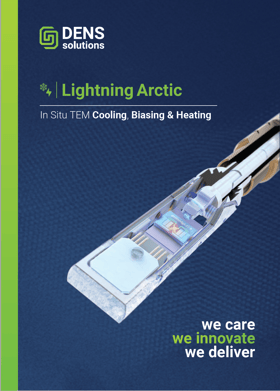
The Lightning Arctic in situ TEM cooling, biasing and heating system lets you observe the real-time dynamics of your specimen under a controllable electrical stimulus, either during cooling with liquid nitrogen or during heating. The double-tilt cryogenic sample holder gives you atomic-resolution stability over long periods, while the MEMS-chip microheater reaches any intermediate point across a wide temperature range.
Operating in two distinct modes, cooling & biasing or heating & biasing, the system unlocks low-temperature physics and lets you correlate the structure, electronic properties and performance of your materials and devices directly.
Why Lightning Arctic
Unlock new possibilities for your in situ experiments
Perform in situ cooling and heating TEM experiments
The Lightning Arctic holder features an integrated cooling rod that establishes an efficient thermal path between the external environment to the MEMS nano-chip at its tip. Connecting this rod to a liquid nitrogen dewar via a cooling braid enables cryogenic cooling inside the TEM column, while the nano-chip heater simultaneously allows precise temperature control of the sample. A combination of the holder-based cooling with chip-based heating extends the system's operational range, allowing users to sweep temperatures from -160 °C to 800 °C within a single experiment.
Experience atomic imaging stability
Engineered for extreme stability, the Lightning Arctic holder integrates dual temperature controllers that actively counteract sample drift during cooling experiments. One controller maintains thermal equilibrium with the TEM column while the other minimizes the environmental influence on the sample. Together with an external LN2 dewar, these controllers enable low-drift atomic-resolution imaging at cryogenic temperatures.
Au nanoparticle at -175 °C
2.65 Mx, 1k × 1k, 1 µs dwell time, 50 frames. Courtesy of Dr. Vladimir Roddatis, GFZ Helmholtz Centre for Geosciences.
Continuous temperature control
Achieve your required sample orientation
The double-tilt Lightning Arctic holder lets you tilt the sample in both alpha and beta directions, orienting the specimen towards the desired zone axis to achieve atomic resolution. Beta tilt reaches ± 15 degrees in the JEOL HRP and WGP pole pieces and ± 20 degrees in Thermo Fisher Scientific S-twin and X-twin, depending on your exact configuration.
Perform in situ biasing experiments while heating/cooling
The Heating and Biasing Nano-Chips let you apply and measure electrical signals during either cooling or heating experiments, with a voltage range of at least ± 40 V.
Because FIB specimen preparation is vital for reliable electrical or electrothermal characterization, we offer proven workflows and dedicated tools, including our specialized FIB stub. This established workflow gives you repeatable, high-quality, short-circuit-free and operational FIB lamellae prepared directly onto the Nano-Chips.
Sample carrier flexibility
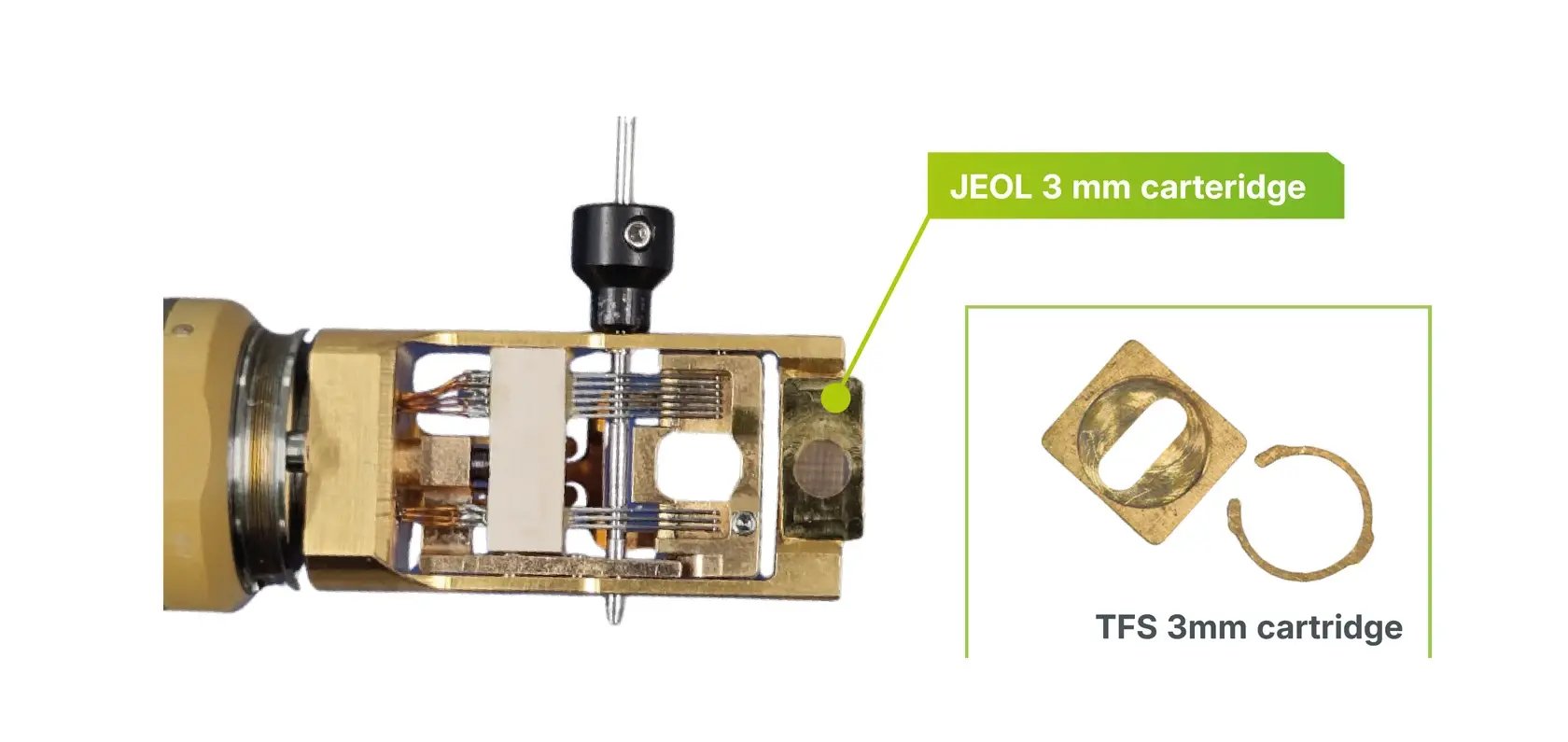
To maximize versatility, the Lightning Arctic system features an interchangeable cartridge that hosts standard, non-MEMS sample carriers. Conventional options such as 3 mm TEM grids or lift-out grids clamp onto the cartridge and go into the holder for stable cryogenic experiments, with cartridges available for both JEOL and Thermo Fisher Scientific microscopes.
Application fields
Lightning Arctic application fields
Ferroelectric materials
Study ferroelectric domain dynamics, phase transitions, and polarization switching at cryogenic and elevated temperatures.
Magnetic materials
Investigate magnetic ordering, domain wall motion, and spin transitions across a wide temperature range.
Quantum materials
Explore quantum phase transitions, superconductivity, and topological phenomena at cryogenic temperatures.
E-beam sensitive materials
Cool beam-sensitive specimens to cryogenic temperatures to slow radiation damage, and keep imaging them at atomic resolution while you do.
System components
In situ cooling, heating & biasing in TEM
Nano-Chip
Sample holder
Liquid nitrogen dewar
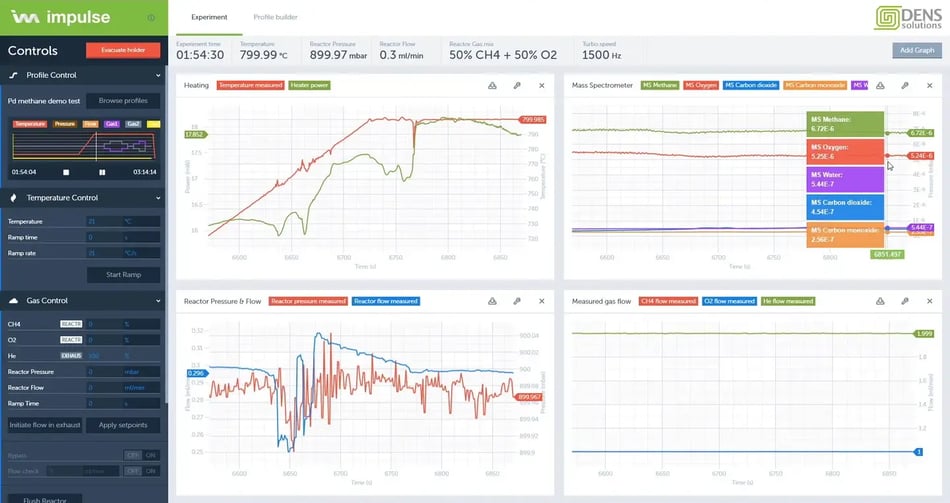
Impulse software
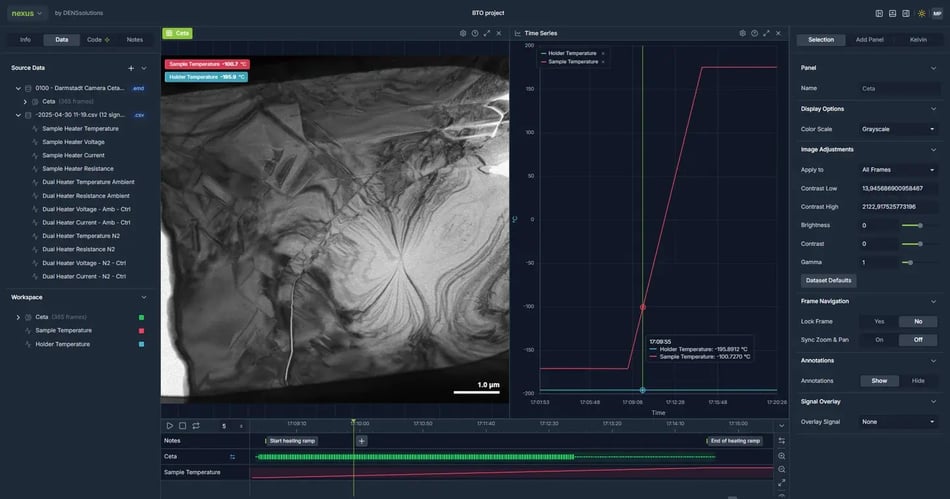
Nexus software
Workflow & benefits
Watch the full workflow
See the complete Lightning Arctic workflow from setup and cooling to atomic-resolution imaging at cryogenic temperatures.
What researchers say
The high stability of the DENSsolutions Lightning Arctic Holder has enabled us to perform variable-temperature ptychography, a technique with stringent requirements for minimal vibration and drift. Using cryogenic multislice electron ptychography, we achieved sub-0.3 Å resolution across temperatures from 100 to 800 K, realizing an experiment I had dreamed of since my postdoctoral days. This capability now allows us to directly track picometer-scale structural distortions across phase transitions in ferroic and quantum materials.
The DENSsolutions Lightning Arctic system enables atomic-resolution cryogenic operando TEM of functional materials, revealing dynamic phase transitions and electrically driven phenomena with unprecedented stability and precision.
I am impressed by the outstanding stability and experimental flexibility of the DENSsolutions Lightning Arctic holder. In particular, its capability to achieve atomic-resolution characterization across a broad temperature range from liquid-nitrogen temperature up to 800 °C is remarkable. This holder serves as an ideal experimental platform for us to investigate the structural and electrical properties of two-dimensional materials at low temperatures.
Publications
Top research using Lightning Arctic
Loading publications…
Frequently asked questions
Find answers to the most common questions about the Lightning Arctic.
Is there a procedure that can help me with FIB sample preparation?
Yes, there is a dedicated sample preparation protocol for heating and biasing nano-chips. Furthermore, every Wildfire and Lightning system includes a dedicated FIB stub that facilitates the process (FIB Stub 3.0: Sample Preparation | DENSsolutions
What is the lowest cooling temperature?
With Lightning Arctic it is always possible to reach a guaranteed temperature of -160 °C. Lower temperatures of -170°C is regularly achievable.
How long does it take before imaging at cryo-EM conditions?
It takes an hour to cool the Lightning Arctic holder down to liquid nitrogen temperatures and to stabilize it.
How long can the holder be kept cooled?
The external dewar holds up to 800 ml of liquid nitrogen, which is enough to run in situ cooling experiments for at least 4 hours without a refill.
What is the beta tilt range of the holder?
Which sample carriers can be used with the Lightning Arctic holder?
The holder is compatible with our MEMS-based heating and biasing Nano-Chips that enable cooling, heating and biasing in situ TEM experiments. Some of these chips are shared between the Lightning and the Lightning Arctic holders. In addition, holder can be used in combination with 3 mm and lift-out TEM grids that greatly expand the sample options.
Can you set intermediate temperatures and how fast does it stabilize?
The microheater of the heating and biasing Nano-Chips are used to change the sample's temperature locally while the whole tip is being cooled. The state-of-the-art chip and heater design enables you to achieve the fast setting of any user-defined temperature and the minimization of the image and focus shift when changing the temperature setpoint, all while ensuring atomic-scale imaging quality. There is virtually no sample stabilization needed to get atomic image resolution imaging at intermediate temperatures when cooling.
Resources
Brochure
Download the Lightning Arctic brochure
For more information on features and specifications.
Download BrochureGet started
Ready to explore Lightning Arctic?
Contact our team to discuss the temperature range and stimuli your experiments need, and receive a tailored Lightning Arctic quote.