Stream Nano-Cell functional and seal chip
Stream

Nano-Cell

MEMS-based sample carrier for (Electro)chemical reactions

The Stream Infinity Nano-Cell is a MEMS-based device that acts as a sample carrier, enabling heating and/or biasing stimuli in a well-controlled liquid environment within an electron microscope.

Nano-Cell

The core of the Stream Infinity system is our patented Nano-Cell, which consists of a functional and seal chip that together form a sealed compartment that enables you to safely perform leak-proof liquid experiments inside the electron microscope. We offer two different Nano-Cells that you can select based on your experimental needs: the liquid + heating Nano-Cell and the liquid + heating + biasing Nano-Cell.
Stream-LHB-chip-zoom-square-edited-480x476

Study (electro)chemistry under realistic liquid conditions

The Nano-Cell enables (electro)chemical experiments in a well-controlled liquid environment, with precise control over flow, temperature and electrochemical stimuli, all while imaging at high resolution inside the electron microscope.

01

Complete flow control

The unique Nano-Cell design includes an on-chip inlet and outlet and a liquid channel, formed by the spacers surrounding them. The liquid runs directly from the inlet to the outlet through the sample area, enabling reliable and reproducible liquid delivery. By manipulating the flow direction in the sample area, electron-beam deposited species can be removed from the observation area.

TEM movie demonstrating Stream's ability to easily dilute and flush away beam-induced species through flow control.

02

Perform electrochemistry

It is possible to measure the electrochemical response of the sample in the Nano-Cell and correlate it with (micro)structural changes. The MEMS-based electrochemical cell consists of three electrodes: Working (WE), Reference (RE) and Counter (CE). In the latest design, the electrodes are parallel to each other and perpendicular to the flow direction, ensuring equal potential distribution and a clean electrochemical environment.

Synchronized STEM movie showing the complete zinc plating/stripping process in 0.1 M ZnSO₄ solution during a CV cycle – By Dr. Shibabrata Basak, FZ Jülich (DOI: 10.1002/smtd.202400081).

03

Perform flow-dependent electrochemistry

The direct flow control in the Nano-Cell, combined with the presence of the WE, RE, and CE electrodes, enables the study of various electrochemical reactions based on liquid flow rate. For instance, decreasing the flow rate can shift metal deposition from a thermodynamically driven to a kinetically driven process, as seen in the video below.

STEM movie showcasing the power of Stream in studying the flow rate dependency on the electrodeposition of copper.

04

Perform temperature-variable (electro)chemistry

Electrochemical reactions are inherently sensitive to temperature variations, and controlling temperature effects is crucial for optimizing electrochemical processes. The Nano-Cell's combined heating and biasing capabilities enable simultaneous investigation of (electro)chemical processes as a function of temperature, providing valuable insights into systems such as batteries and fuel cells.

TEM movies depicting copper plating and stripping at 30 °C and 90 °C – Courtesy of Prof. Joe Patterson, UC Irvine.

Gas Purging

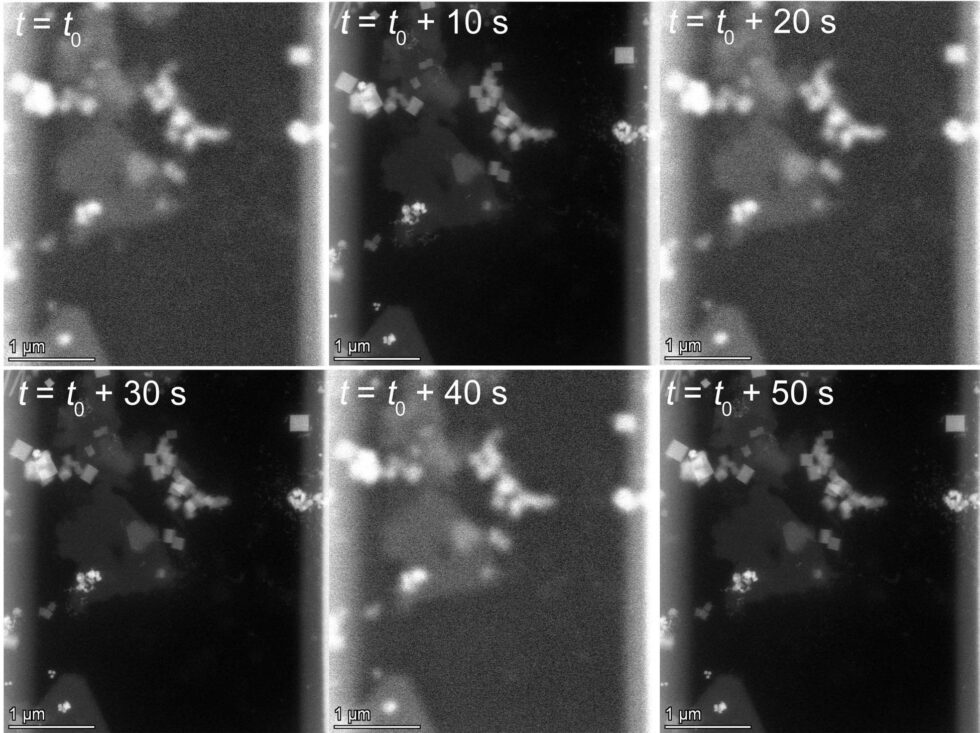
Thanks to the on-chip flow capability of the Stream Nano-Cell and the usage of the pressure-based pumps, the liquid in the field of view can be temporarily removed from the imaging area by flowing (inert) gas, which is termed “purging”. This purging method can improve the (S)TEM imaging resolution, as well as the chemical and electronic analysis of your sample via energy-dispersive X-ray spectroscopy (EDX) and electron energy-loss spectroscopy (EELS), respectively.
Stream-NC-gas-purging-980x733

Easy sample preparation

Loading the sample onto the MEMS-based Nano-Cell is easy and fast to perform. This can typically be done either via a process of dropcasting or via a FIB lamella. The electrochemical method of sample deposition is also possible but not considered here.

Dropcasting the sample

Nanoparticles are typically in powder form and are prepared in an ethanol or water solution for direct dropcasting onto the Nano-Cell's electron transparent windows.

Download the dropcasting sample preparation guide
Stream dropcasted gold nanoparticles

STEM image showing dropcasted gold nanoparticles on the membrane of the Stream liquid biasing chip.

FIB lamella

Using a dedicated procedure, it's also possible to prepare a FIB lamella on the Stream Infinity functional chip in a dual beam either for heating and/or biasing experiments.

Download the FIB Lamella sample preparation guide
Stream FIB lamella example

Sample courtesy of Dr. A. Kosari, TU Delft.

Ready to explore Stream?

Contact our team to discuss the Nano-Cells your experiments need, and receive a tailored quote.